16 Jul 2026
How Animation Frame Rates Shape Transitions from Trial Credits to Deposited Play in Cross-Format Casino Apps
Animation frame rates in cross-format casino applications determine how fluidly graphics render on mobile devices, and this technical element directly influences whether users move from trial credit periods into real-money deposits. Research from the International Center for Gaming Regulation at the University of Nevada indicates that applications running at 60 frames per second maintain consistent motion during reel spins and card flips, whereas those locked at 30 frames per second display noticeable stutter when multiple symbols align or when bonus rounds trigger. Observers note that these differences become most apparent during the shift from practice modes to deposited play because players already familiar with the interface expect the same visual smoothness once real funds appear on screen.
Device hardware capabilities set the baseline for frame rate performance across both slot and video poker formats. Smartphones released after 2024 commonly support variable refresh rates up to 120 hertz, allowing developers to scale animation output dynamically. When an app detects stable network conditions and sufficient battery levels, it increases frame delivery during key transition moments such as the final spin before a credit balance depletes. Data compiled by the American Gaming Association shows that apps employing adaptive frame scaling recorded conversion rates from trial credits to deposits that were 12 percent higher than fixed-rate counterparts during the first half of 2026.
Frame Rate Effects on User Interface Continuity
Slot animations rely on rapid symbol movement across vertical reels, while video poker sequences emphasize card flips and hold selections. A consistent frame rate across both formats prevents visual interruptions that could prompt users to exit before committing funds. Experts at the Canadian Centre for Gaming Research have documented that frame drops below 45 frames per second during poker hand resolutions correlate with a measurable drop in session continuation, particularly when trial credits transition into deposited balances. Developers therefore prioritize GPU optimization routines that allocate rendering resources evenly between reel simulations and card mechanics within the same application binary.
Cross-platform synchronization further complicates frame rate management. When a user begins a session on a tablet and later switches to a smartphone, the application must recalibrate animation timing to match the new display's refresh characteristics. Reports issued in July 2026 by the Nevada Gaming Control Board highlight that synchronized sessions maintained higher deposit activity when frame rates remained above 55 frames per second on both devices, reducing the perception of lag that often accompanies format switches.
Conversion Metrics Across Trial and Deposited Sessions
Conversion from trial credits to deposited play depends on how seamlessly teh visual experience carries over once real currency enters the balance. Applications that sustain high frame rates during the final spins of a trial session create continuity that encourages immediate deposit prompts. Figures released by the Australian Gambling Research Centre reveal that 60-frame-per-second implementations produced a 9 percent increase in deposit events within the first minute after trial credit exhaustion compared with lower-rate versions. This pattern holds across both reel and poker formats because players experience uninterrupted feedback loops that reinforce perceived fairness and responsiveness.
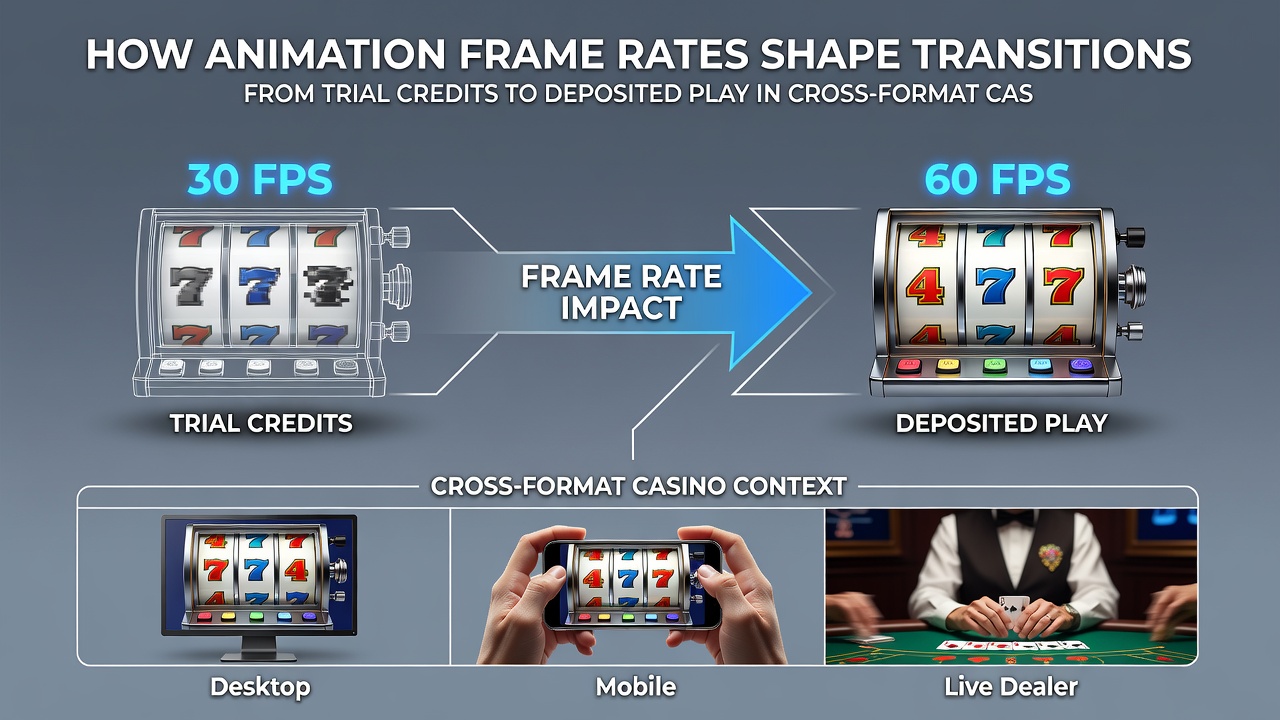
Memory management on portable devices also affects sustained frame delivery. Background processes and thermal throttling can reduce animation output mid-session, breaking the visual consistency required for smooth transitions. Engineers address this by implementing frame-rate throttling thresholds that activate only when temperatures exceed safe operating ranges, thereby preserving animation quality during the critical window when users decide whether to deposit. Industry analysts tracking app telemetry note that such thermal-aware adjustments correlate with longer average session durations once real funds activate.
Regional Regulatory Observations on Animation Standards
Regulatory bodies increasingly examine animation performance as part of broader responsible gaming frameworks. The Gaming Policy and Enforcement Branch of British Columbia requires that casino applications maintain minimum frame rates during both free and paid play to avoid misleading visual cues. Compliance testing conducted in spring 2026 confirmed that apps meeting these thresholds showed stable progression from trial credit usage to deposited activity, with no statistically significant increase in rapid deposit attempts following frame-rate drops. Similar guidelines have emerged in Singapore's Remote Gambling Act enforcement documents, which emphasize consistent rendering across device types to support transparent gameplay experiences.
Academic studies continue to explore the precise relationship between frame delivery and player decision points. A 2025 paper from the School of Interactive Arts and Technology at Simon Fraser University analyzed eye-tracking data from over 800 participants and found that smooth 60-frame sequences held visual attention 18 percent longer during the transition moment when trial balances reached zero. Those findings suggest that animation continuity functions as a subtle retention mechanism rather than an overt persuasion tool.
Future Development Directions
Emerging hardware such as foldable displays and high-refresh-rate tablets introduces new variables for frame-rate optimization. Developers must now account for variable screen geometries while preserving animation fluidity across slot and poker modules. Early adoption data from major platform providers indicates that applications already supporting dynamic frame scaling achieve more consistent conversion performance when users migrate between device form factors. Continued monitoring by regulatory and research entities will clarify how these technical refinements influence long-term engagement patterns in cross-format casino environments.
Conclusion
Animation frame rates serve as a foundational technical factor that shapes whether trial credit experiences translate into deposited play within cross-format casino applications. Evidence from regulatory reports, academic research, and industry telemetry demonstrates measurable effects on session continuity and conversion timing across slot and video poker formats. As device capabilities advance and regulatory expectations evolve, sustained attention to frame-rate management remains central to maintaining consistent visual experiences that support user progression from practice to real-money participation.